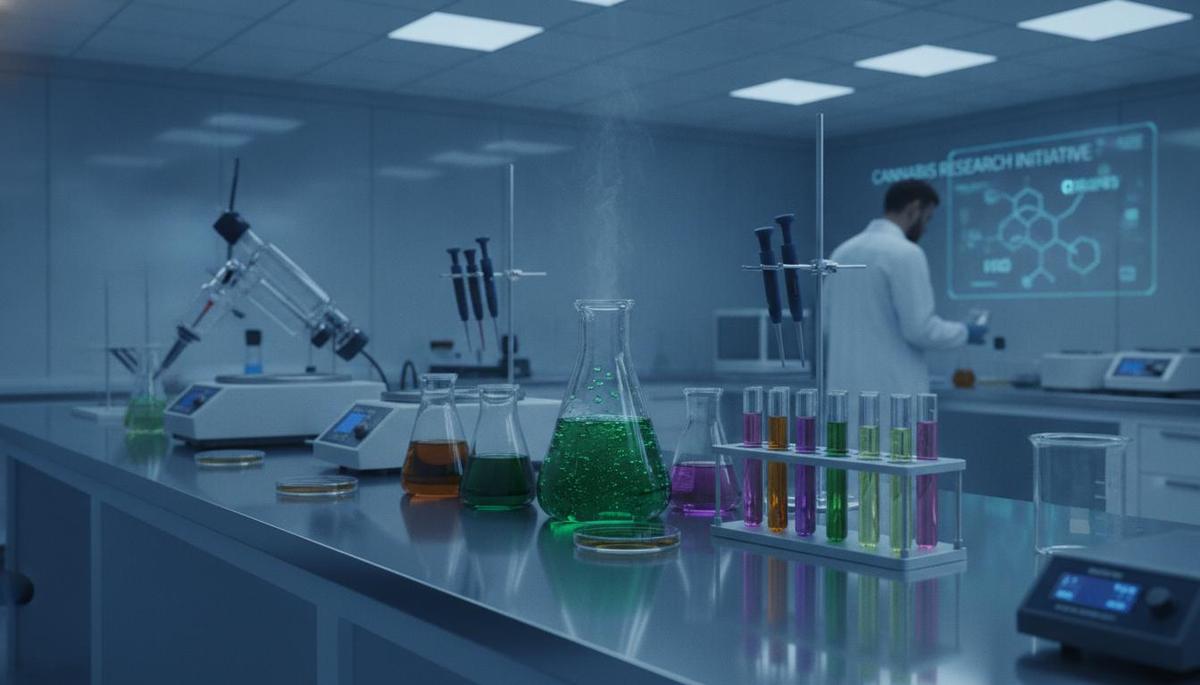
Tetrahydrocannabinol is a lipid-soluble molecule, meaning it dissolves in oils and fats but not in water. This fundamental chemical property created the central challenge for cannabis beverage manufacturers: how to incorporate an oil-based compound into a water-based drink in a way that produces stable, consistent, and palatable products. The solution, water-soluble THC through nano-emulsification, represents one of the most significant technological innovations in the cannabis industry. This article explores the chemistry, engineering, and practical implications of making THC water-compatible.
Why THC Is Oil-Soluble
THC's molecular structure consists of a hydrocarbon backbone with minimal polar groups. This makes it hydrophobic, literally "water-fearing." The molecule has high lipophilicity, meaning it readily dissolves in nonpolar solvents like oils, fats, and organic solvents. When you try to mix THC oil with water, the two substances separate because THC molecules are more attracted to each other and to oil molecules than to water molecules. This separation creates visible oil droplets, inconsistent dosing, and poor absorption.
Approaches to Water Compatibility
Nano-Emulsification
The dominant approach breaks THC oil into microscopic particles (20-200 nanometers) and surrounds them with a surfactant/emulsifier that allows them to remain stably suspended in water. This creates the appearance of dissolution without actually changing THC's fundamental chemistry. Nano-emulsions are kinetically stable (they don't separate quickly) even though they're thermodynamically unstable (they would eventually separate given enough time).
Liposomal Encapsulation
An alternative approach encapsulates THC in liposomes, spherical vesicles made from phospholipid bilayers similar to cell membranes. The THC sits inside the hydrophobic core of the liposome, while the outer surface is water-compatible. Liposomes may offer enhanced absorption and protection from degradation.
Complexation
Cyclodextrins are ring-shaped sugar molecules that can encapsulate hydrophobic molecules in their central cavity, creating complexes that behave as water-soluble. This approach is used in some pharmaceutical applications and is being explored for cannabinoids.
Surfactant Micelles
Surfactant molecules can form spherical aggregates called micelles in water, with hydrophobic interiors that can solubilize THC. This is similar to nano-emulsification but uses different chemical structures.
How Nano-Emulsification Creates Water-Soluble THC
The nano-emulsification process involves: dissolving THC extract in a carrier oil; combining with emulsifiers (surfactants that have both water-loving and oil-loving ends); applying high-energy processing (high-pressure homogenization, ultrasonication, or high-shear mixing); creating droplets so small that Brownian motion keeps them suspended rather than rising or falling; and stabilizing with additional emulsifiers or stabilizers. The resulting nano-emulsion appears clear or slightly hazy and remains stable for months.
Why Particle Size Matters
Particle size directly affects: stability (smaller particles are more stable); clarity (particles below 100nm don't scatter visible light, creating transparent products); absorption (smaller particles cross biological membranes more easily); bioavailability (smaller particles have higher surface area-to-volume ratios); and taste (smaller particles don't create oily mouthfeel). Premium manufacturers aim for particles under 100nm for optimal performance.
Challenges in Water-Soluble THC Production
Creating stable, effective water-soluble THC presents ongoing challenges: oxidation stability (small particles have high surface area and may oxidize faster); pH sensitivity (some emulsions break at extreme pH values); temperature sensitivity (high heat can destabilize emulsions); taste masking (some emulsifiers have off-flavors); scalability (lab processes don't always scale to production volumes); and cost (quality nano-emulsification equipment and expertise are expensive). Overcoming these challenges separates premium products from mediocre ones.
Future Innovations
Research continues into improved water-solubilization methods: nano-crystal suspensions of pure THC without oils or emulsifiers; improved natural emulsifiers with better taste profiles; microencapsulation for controlled release; and co-crystal technology creating true solid solutions. These innovations promise even better bioavailability, stability, and taste in future THC beverages.
Conclusion
Water-soluble THC, achieved primarily through nano-emulsification technology, is the foundation upon which the entire cannabis beverage industry rests. By breaking oil-based THC into nanoscale particles that can remain suspended in water, manufacturers created products that are stable, clear, consistently dosed, and rapidly absorbed. While the technology continues to evolve, current water-soluble THC formulations represent a remarkable achievement that has made cannabis beverages one of the fastest-growing segments in the industry. Understanding this technology helps consumers appreciate the science behind their drinks and evaluate product quality.